
Trade, tariffs, and embargoes
Last updated on December 1st 2025
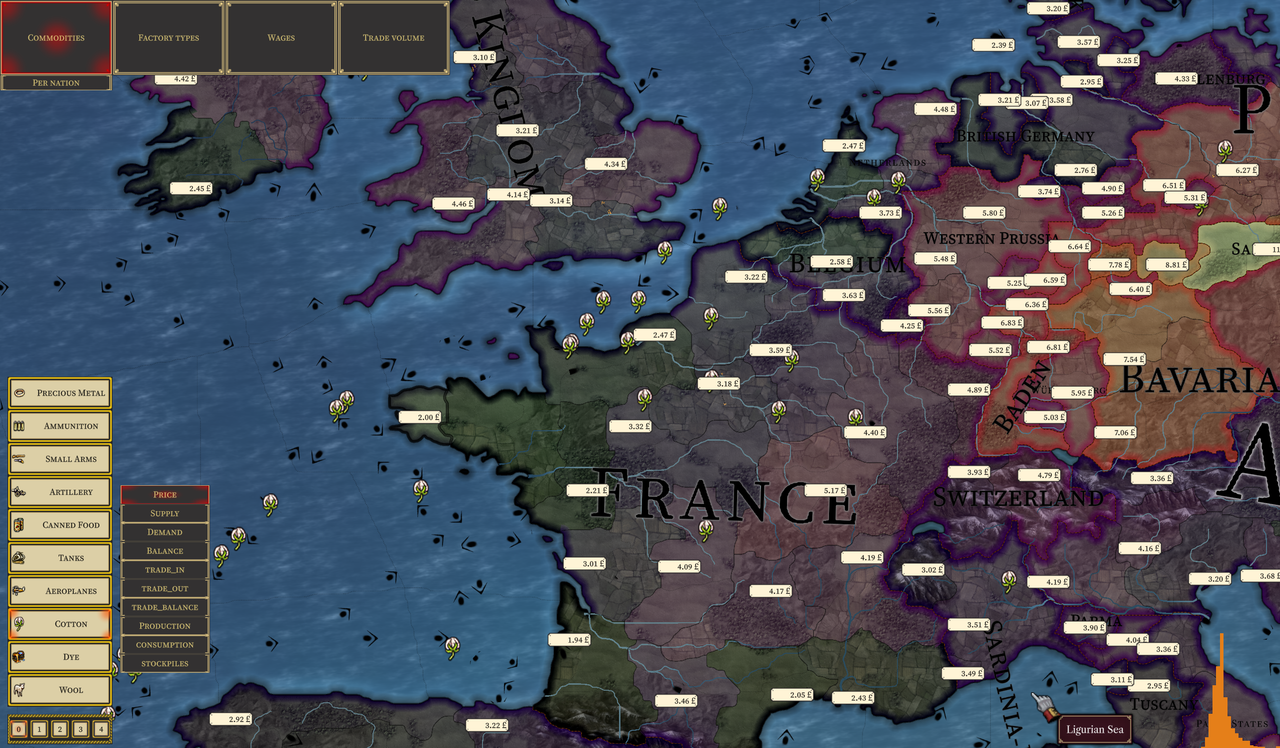
In Project Alice, trade is simulated on state-level with states having trade routes between each other.
Trade route placement is impacted by geography (effective distance between provinces impacted by rivers and terrain maluses), transport infrastructure (railways and ports), and population of states. Lowering tariffs will NOT create extra trade routes. Land trade can only connect two neighbouring states. Naval trade can connect only two sea-adjacent states. Game always tries to link between every owned state and nation capital.
To see the trade routes a state has, navigate to province tab and select a good on the local market subwindow.
Trade route volume. Route "actual volume" shows the actual volume of goods transferred. It's impacted by prices on both sides of the route, tariffs, and distance. Game calculates transport costs per unit of commodity assuming that 1 unit of every commodity has the same volumetric weight. Every unit of distance increases the delivery price by 0.05£.
State trade throughput has limited capacity which is determined by:
- State population;
- Railways;
- Ports.
Transportation losses. When a commodity is moved, a part of the commodity is lost. This fraction can be reduced with faster transportation achieved through transportation infrastructure.
State purchases (army, navy, national stockpile) are done in the capital. Construction materials are purchased locally.
Market stockpiles. Traders have a separate stockpile and budget which they use to import and export goods. Profits from trade (5% markup) go to money stockpiles of local markets and then are shared among capitalists, artisans and clerks, where capitalists have the highest weight, clerks have an average weight and artisans have a really low weight during distribution of money. If there are no artisans, clerks and capitalists, money remains in the market coffers.
Embargoes
Conditions for Trade routes shutting due to Blockades. Land trade routes jump a single neighbouring state. Thus, to maintain a land trade route you need an uninterrupted line of bordering states between the producer and the consumer. Naval trade routes connect two coastal states on a significant distance. To maintain a naval trade route neither the source nor the origin state should be blockaded.
During war, control of the state market goes to the country occupying the state trade capital (the province that has the trade center). For example, as long as Germany occupies Elsace-Lorraine, the state can trade with Germany and countries neutral/allied to Germany, but not with France.
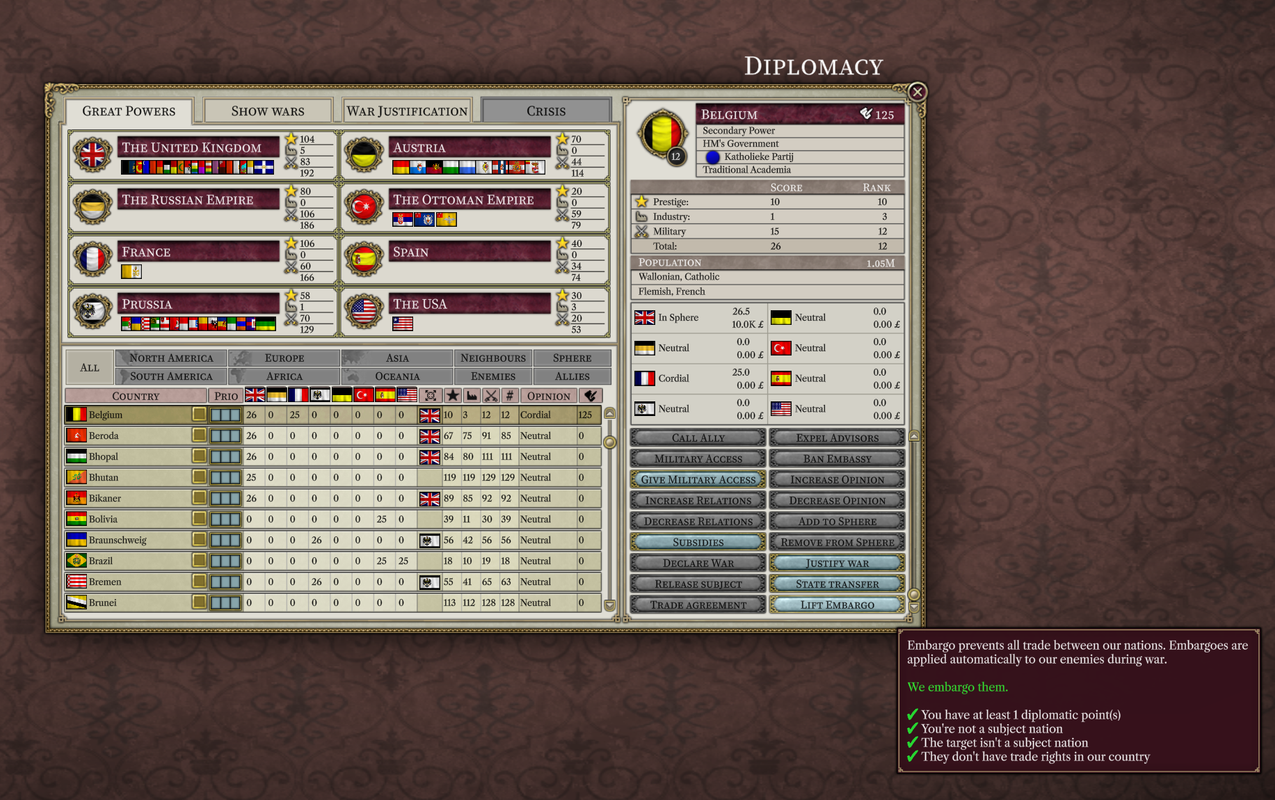
Conditions for Trade routes shutting due to Embargo:
- Origin and target are at war, OR
- Origin is embargoing target, OR
- Target is embargoing origin. AI would embargo all nations that went over infamy limit.
Tariffs
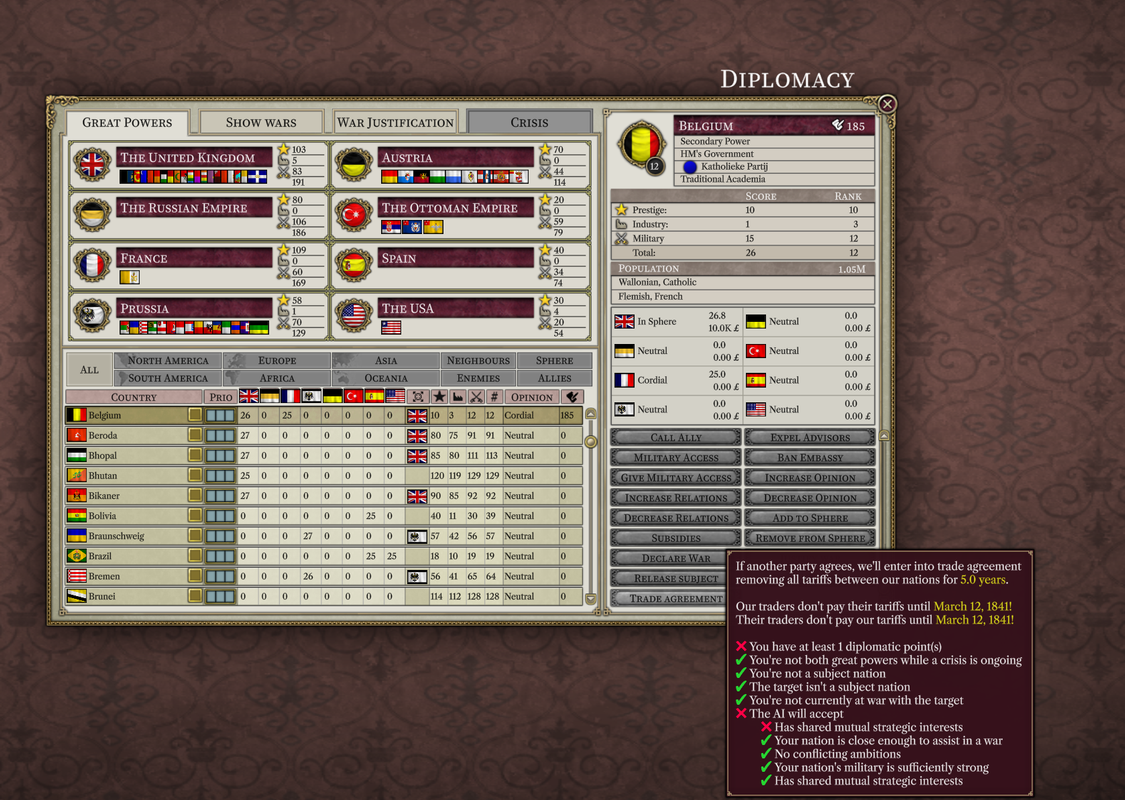
Tariffs are taken on goods moving in or out of the country. In case of an international trade route, both countries (exporter and importer) take tariffs. Effective tariffs = tariff slider value * national bureaucratic efficiency.
Trade route won't pay tariffs of the nation if that nation is either:
- Subject of the other party;
- Sphereling of the other party;
- Has free trade agreement with the other party;
- Was forced to sign unequal treaty by the other party (a CB type);
AI always sets tariffs to 10%. Therefore, if you have more expensive/less productive labour than the AI you are competing with - raise tariffs higher than theirs. This way you protect domestic industry from unfair competition. If you have cheaper/more productive labour than the AI you are competing with - lower tariffs lower than theirs. This way you support exports that will suppress other country's industry. Reasonable number of tariffs help avoid closure of your factories and massive unemployment.
With 100% tariffs and 100% administrative efficiency, you will block all trade going in or out.